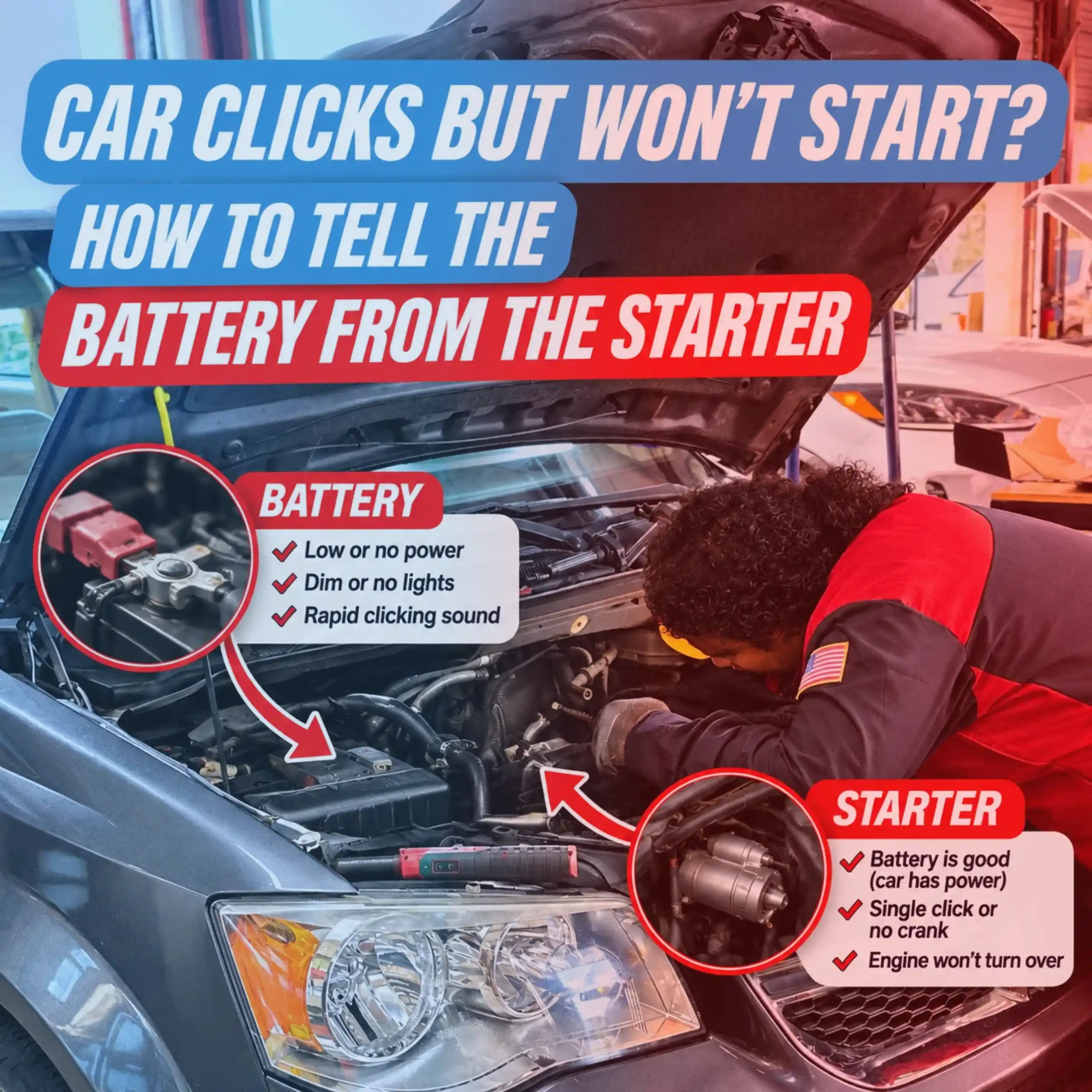
You turn the key or press the button, and instead of the engine you hear clicking. It’s one of the most frustrating sounds a car can make, usually in a parking lot when you’re already running late. The good news is that the sound itself is a useful clue, and in many cases the fix is straightforward.
Rapid clicks vs. one loud click
Rapid clicking
One loud click
Rapid clicking usually means the starter is getting some power, but not enough to crank the engine. The most common reason is a weak battery, followed by loose or corroded battery terminals.
One loud click usually means the battery may have enough power, but the starter isn’t turning the engine. That can point to a failing starter or solenoid, or a poor connection on the starter circuit.
No sound at all
No sound at all can mean a completely dead battery, a bad connection, a blown fuse, or a problem with the ignition or security system.
A normal cranking sound but no start
A normal cranking sound but no start is a different problem. The battery and starter are likely doing their jobs, so the cause is more often fuel, spark, or an engine sensor.
Battery, alternator, or starter?
| Clue | Likely culprit |
| Dim lights and rapid clicking | Battery or connections |
| Starts with a jump, then runs fine | Battery, or a charging problem |
| Starts with a jump, then dies soon after | Alternator |
| Bright lights, one click, no crank | Starter or starter circuit |
| Battery light on while driving | Charging system |
| Lights dim or flicker while driving | Alternator |
| Grinding when you start the car | Starter gear or flywheel teeth |
| Works sometimes, then not at all | Failing starter or a loose connection |
What to try safely
-
- Turn off the headlights, radio, and AC.
-
- Look for loose or corroded battery terminals, with the car off. White or green buildup is a clue.
-
- Try a jump start using the steps in your owner’s manual. Hybrids and some newer cars have specific procedures.
-
- If the car starts, drive straight to a shop. Don’t assume the problem is gone.
If you smell something rotten or see a swollen, cracked, or leaking battery, leave it alone and have the car towed.
Why batteries fail so early in Houston
Most people think cold kills batteries, but in our shop we see heat do more damage. High under-hood temperatures speed up the chemical wear inside the battery. Batteries generally last three to five years, and in Houston heat we often see them give out closer to the three-year mark.
That damage often stays hidden through the summer. Then the first cold front arrives, the engine needs more power to start, and a battery that seemed fine suddenly isn’t. That’s why we recommend a battery load test every year once your battery is three years old.
Don’t replace parts on a guess
A new battery won’t last if the real problem is a bad alternator that isn’t recharging it. It also won’t last if a parasitic drain is pulling it down while the car is parked. In newer cars, a door module, a dash camera, or a poorly wired accessory can all do that. That’s why a proper test looks at the battery, charging system, starter, and drain together.
Get your starting problem solved in Houston
The team at West End Auto Works load-tests batteries and diagnoses alternators, starters, parasitic drains, shorts, and module faults using manufacturer-level diagnostic equipment. We find the actual cause, so you are not buying parts you don’t need. If your car won’t move at all, we work with local towing providers, and you can ask about our shuttle when you drop off.
Call us at (281) 879-9999 or stop by 13505 Alief Clodine Rd, Houston, TX 77082 to book a battery and charging system test.
Learn more on our Electrical & Starter Repair page.