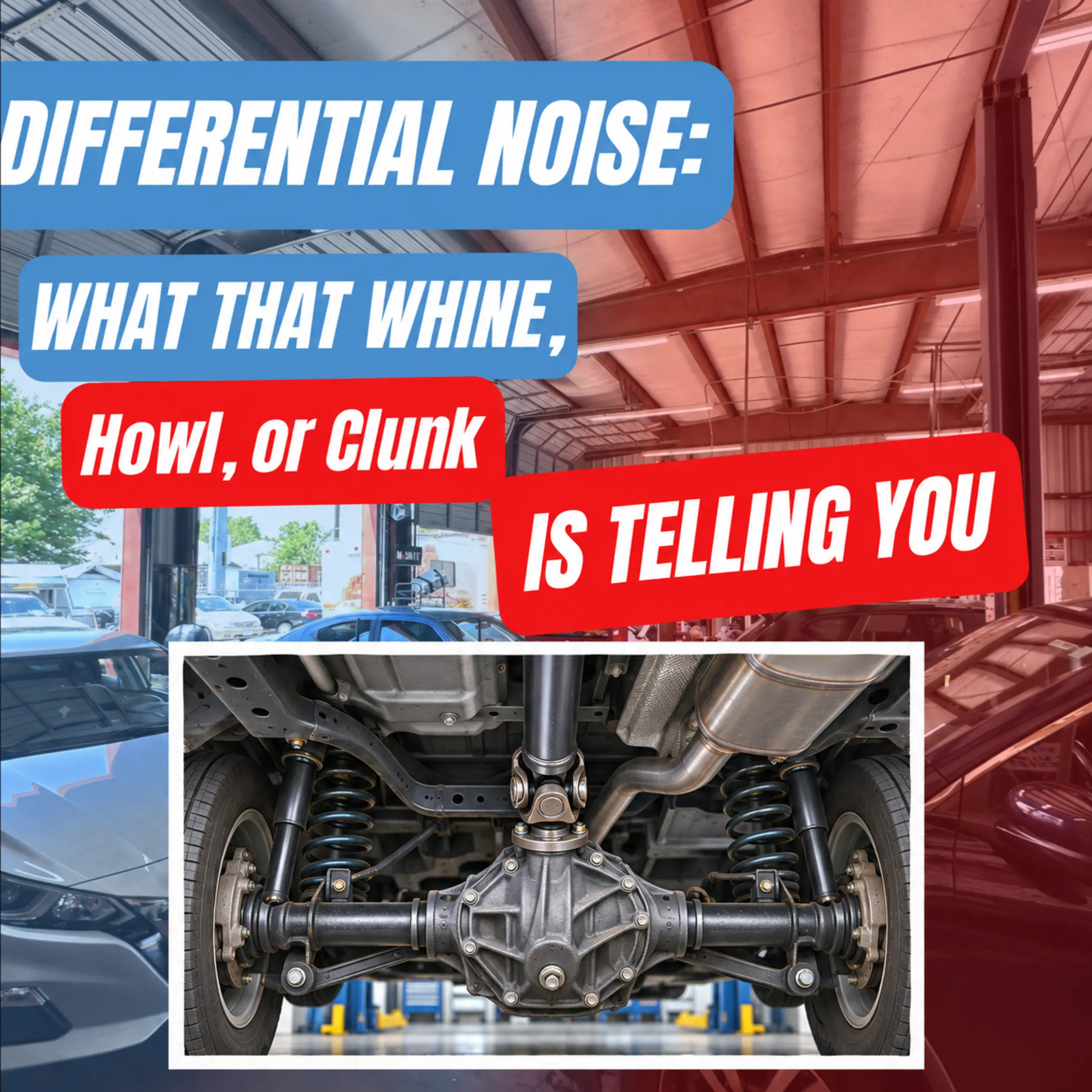
A new whine from under your truck or SUV is easy to blame on the tires, and sometimes that is the right call. But if the sound rises and falls with your speed, or changes when you press or lift off the gas, your differential may be asking for attention. Catching it at the fluid stage is much cheaper than catching it at the broken-gear stage.
What your differential does
When you turn a corner, your outer wheels travel farther than your inner wheels. The differential lets them spin at different speeds while still sending power to the road. Inside are gears and bearings that work under heavy pressure and depend on a dedicated gear oil.
Rear-wheel drive vehicles have one at the rear axle. Front-wheel drive cars build theirs into the transaxle. All-wheel and four-wheel drive vehicles may have front and rear differentials plus a transfer case or coupling.
What each noise can point to
| What you hear | When it happens | Possible cause |
|---|---|---|
| Whine or howl | While accelerating | Worn ring and pinion gears, or gears out of adjustment |
| Whine | While coasting or slowing down | Worn pinion bearings or loose pinion preload |
| Steady whine or hum | At all times, rising with speed | Carrier or pinion bearings, or low gear oil |
| Clunk | Shifting into gear or getting on the gas | Excess gear play or worn U-joints |
| Chatter or shudder | During tight, slow turns | Limited-slip clutches or worn fluid |
| Repeating click or knock | Steadily as the wheels turn | Damaged gear teeth |
These are clues, not a diagnosis. The same sound can have more than one cause, and it takes an inspection to confirm which one you have.
Is it the differential or a wheel bearing?
The two are easy to confuse. On an empty, safe stretch of road, swerve gently left and right at a moderate speed. Noise from a bad wheel bearing often changes as you load each side. Differential noise usually doesn’t. Tires can also hum, especially with uneven wear, so a good inspection checks those too.
Other warning signs
- Dark, thick gear oil leaking near the center of the axle
- A strong sulfur smell, which is typical of gear oil
- Vibration that grows with speed
- Metal particles in the old gear oil
Why differential fluid matters
Gear oil is often forgotten because it isn’t part of a routine oil change. Yet it cushions and cools gears under heavy load, and it wears out too. A common guideline is every 30,000 to 50,000 miles, and more often for trucks, SUVs, and anything that tows. Your owner’s manual has the schedule for your vehicle.
Be aware that fresh fluid can’t repair worn gears or bearings. Also, many limited-slip differentials need a specific additive or fluid, so the wrong product can cause chatter.
When to get it checked
A faint new whine means schedule an inspection soon, and check for leaks. A loud or worsening noise, grinding, or a clunk that gets harsher means limit your driving and have it looked at right away. A differential that locks up can damage nearby parts and can leave you stranded.
Why Houston driving adds up
Constant stop-and-go traffic loads and unloads the gears thousands of times, and summer heat works the gear oil harder. Add the trucks and SUVs that tow boats and trailers across Southeast Texas, and it pays to stay ahead of this service.
Get your differential checked in West Houston
The team at West End Auto Works services FWD, RWD, AWD, and 4WD vehicles, from differential fluid changes to rebuilds, CV axles, driveshafts, U-joints, and transfer cases. We will pinpoint the source of the noise, show you what we find, and tell you what needs attention now and what can wait.
Learn more on our Drivetrain & Differential page.